

Multi-asset tokenization infrastructure
Tokenization infrastructure for multiple real-world asset classes
Structure tokenization around the economics of the underlying asset, investor rights, transfer rules, compliance requirements, and lifecycle of the instrument.
Trusted by forward-thinking issuers
Investor RightsDefined
Whitelist RulesConfigured
Mainnet ReadyWorkflow
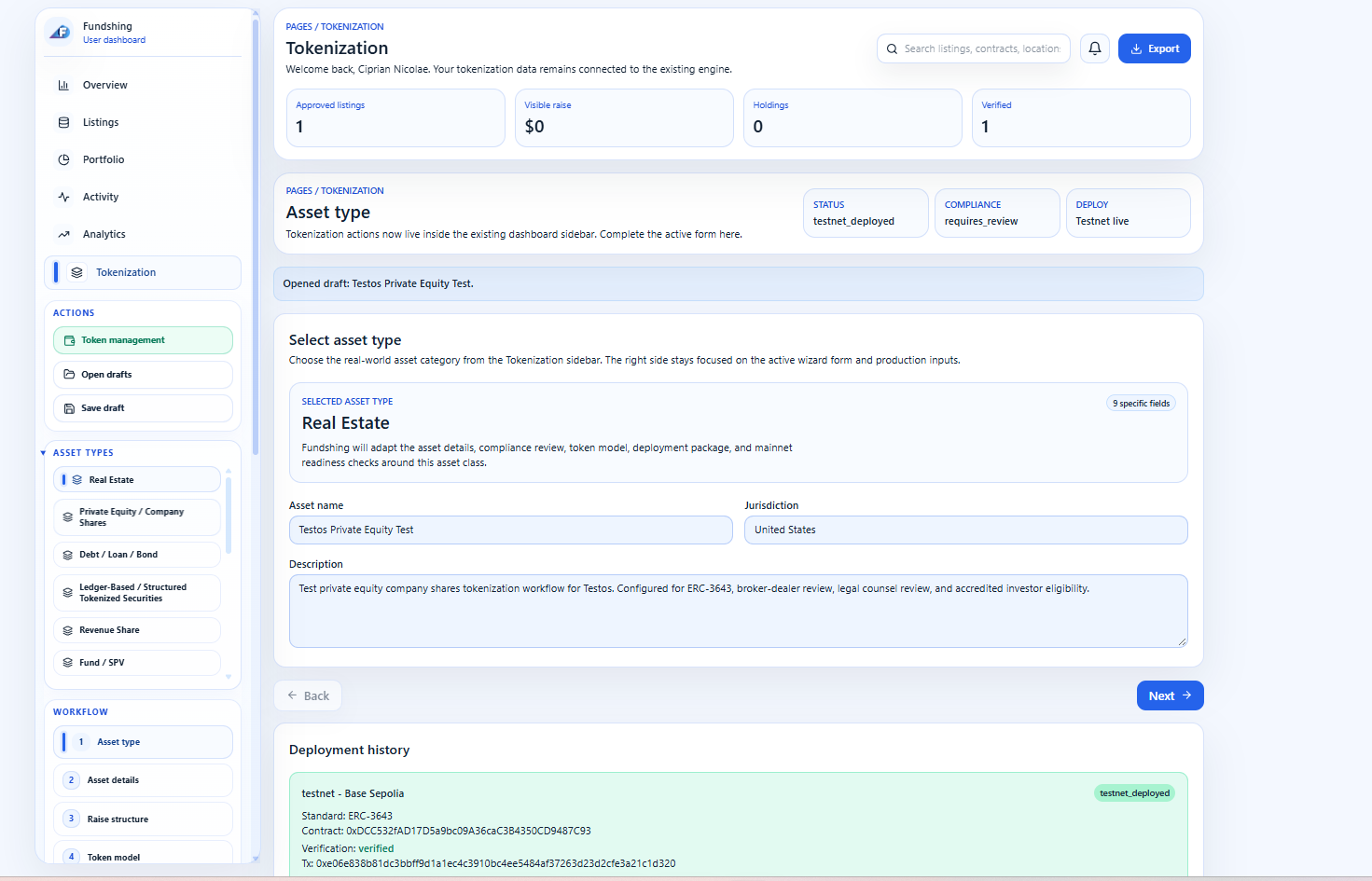
Start with the asset, not the token
Every tokenization project begins with the underlying economic relationship. Fundshing helps issuers configure the technology around the real asset, legal structure, investor rights, cash flows, transfer restrictions, and operational requirements.
- Asset
- Legal & Economic Structure
- Investor Rights
- Token Model
- Compliance Rules
- Launch & Operations
Supported asset classes
Choose an asset model and structure it with the controls it actually needs.

Real Estate
Commercial property, residential portfolios, mixed-use developments and property-backed SPVs.
Typical structures:Direct ownership, SPV equity, property debt, fund interestsExplore Real Estate
Private Equity / Company Shares
Growth equity, shareholder liquidity, private placements and preferred share structures.
Typical structures:Ordinary shares, preferred equity, shareholder interestsExplore Private Equity / Company Shares
Debt / Bonds / Loans
Corporate debt, private credit, structured notes and project finance instruments.
Typical structures:Secured notes, bonds, loans, revenue-backed debtExplore Debt / Bonds / Loans
Funds / SPVs
Private funds, venture vehicles, special-purpose entities and co-investment structures.
Typical structures:Fund interests, SPV participation, feeder structuresExplore Funds / SPVs
Revenue Share
Tokenized participation in royalties, contract cash flows and revenue-generating projects.
Typical structures:Revenue participation, royalties, cash-flow sharingExplore Revenue Share
Commodities
Physical commodities, warehouse-backed assets and commodity-linked structures.
Typical structures:Allocated holdings, reserves-backed units, inventory-linked rightsExplore CommoditiesCustom structures are available for specialized real-world asset projects.
Featured case studies
View all case studies
Northbridge Growth Partners
A structured path for a private-market sponsor to connect asset evidence, investor eligibility, and controlled lifecycle operations.
Private markets
Atlas Renewables
An instructional model for infrastructure teams coordinating project evidence, financing terms, and stakeholder reporting.
Energy infrastructure
Meridian Private Credit
A controlled operating model for note issuance, evidence review, investor access, and servicing-ready reporting.
Private creditChoosing the token structure
| Economic structure | Typical token model | Operational focus |
|---|---|---|
| Company equity | Permissioned security token | Ownership, transfer controls, investor registry |
| Debt instrument | Fungible debt token | Issuance, coupon payments, redemption |
| Fund or SPV interest | Permissioned fund-interest token | Subscriptions, ownership records, reporting |
| Individual physical asset | NFT or semi-fungible model | Traceability, ownership mapping, documentation |
| Revenue participation | Economic-right token | Cash-flow allocation, distributions, reporting |
The legal instrument defines investor rights. The token represents and operationalizes those rights on-chain.
How every asset moves through Fundshing
- 1Define AssetCapture key details
- 2Upload EvidenceLegal, financial, KYC
- 3Configure StructureLegal, financial and terms
- 4Set Token ModelToken mechanics
- 5Configure ComplianceEligibility and restrictions
- 6Test on TestnetValidate end-to-end
- 7Launch on MainnetGo live with controls
- 8Manage Post-LaunchMonitor, report and scale
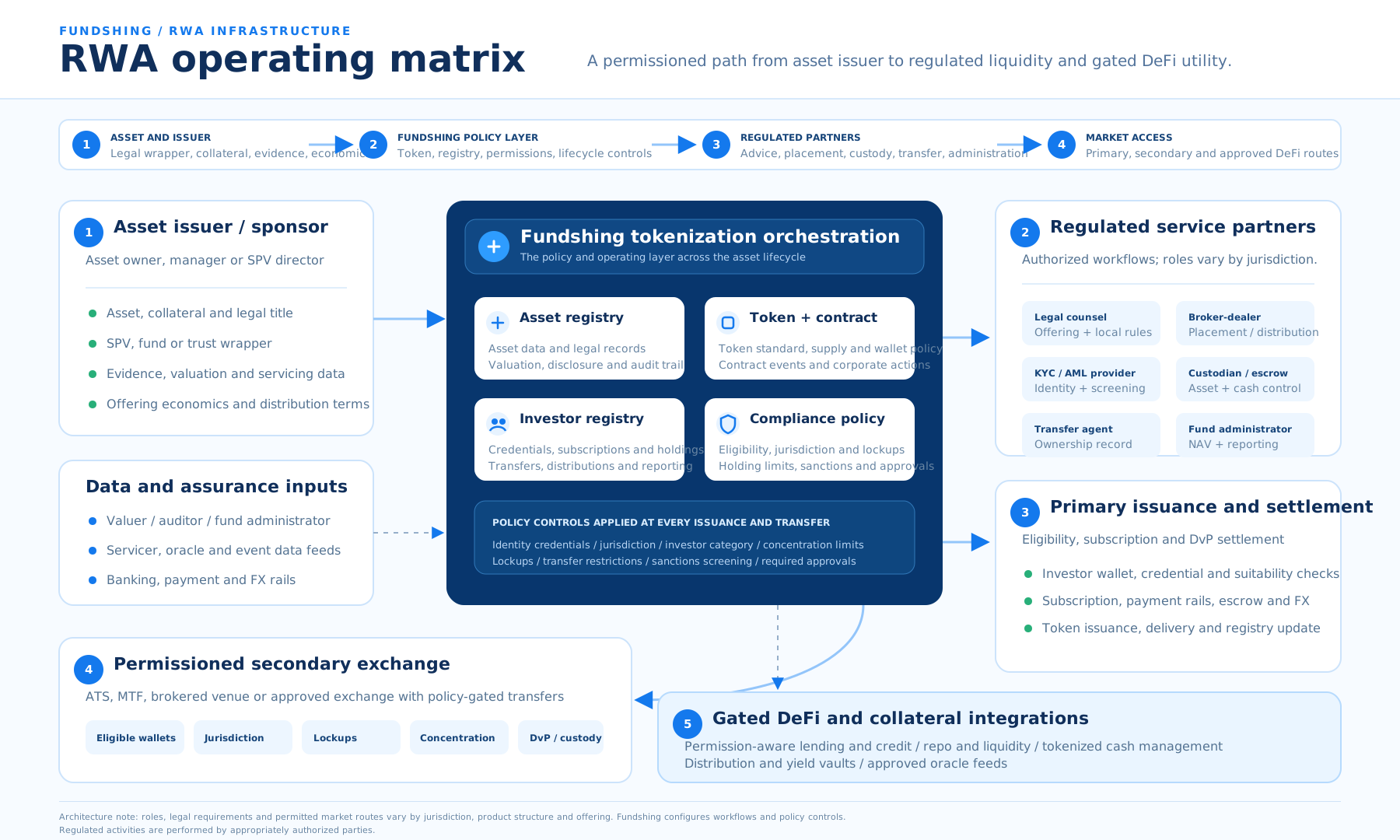
Why issuers use Fundshing across asset classes
Asset-first approach
Model the real asset, investor rights, and structure before deployment.
Flexible token standards
Support for ERC-3643, ERC-1400, and other institutional standards.
Controlled workflow
Role-based review, evidence management, and launch-readiness checks.
Built for real operations
Go beyond issuance with reporting, distributions, and lifecycle management.
Have an asset that needs the right tokenization structure?
Book a conversation and explore how Fundshing can support your asset, workflow, and launch path.